Do You Believe in Clod?

doyoubelieveinclodCameron and Jack had been sitting in the co-op having breakfast. Cameron was Jack’s younger brother. Sometimes, when Jack had to listen to Cameron talk for long periods of time he would wish that—unbeknownst to anyone—the impending nuclear holocaust had been focused on Sweetditch, the town in which they lived and were having breakfast, and that the enemies of the Empire had chosen this moment to execute their terrible vengeance, because that would mean that the conversation could end.

Cameron was finishing an anecdote.

“But then I’m like, ‘I don’t care if it’s sterile, it’s not mine.’” Cameron searched Jack’s face for a reaction.

“Isn’t that great?” Cameron said. “Did you like that?”

“No,” Jack’s mouth said, and Jack’s mouth meant it.

Cameron nodded, and then said something that Jack did not expect him to say. 

“Do you believe in Clod?” he said.

Jack was surprised by the sudden theological turn the conversation seemed to be taking. But he wasn’t sure he’d heard right.

“Do you mean God?” Jack said.

“I’ll ask you again: Do you believe in Glod?” Cameron said.

“I can’t tell what you’re saying,” Jack said.

“It’s a simple question, about your belief in Grawd.”

Jack looked out the window, hoping to see a mushroom cloud blooming on the horizon.

“What’s the point of what you’re doing?” he said.

“I’m just curious what your metal-physical views are,” Cameron said.

Jack felt he was being drawn into a trap.

“It’s meta-physical,” he said. “I can’t believe that you know that word well enough to get it wrong.”

“That’s what she said,” Cameron said.

“Up until just about fifteen seconds ago, I did believe in God,” Jack said.

“That’s what she said,” Cameron said.

Jack took a sip of his coffee and fantasized that someone had somehow put strychnine in it just a split-second before. The fantasy spurred him to finish the cup in one swallow.

Why would you do this to someone?” he said.

Cameron smiled suddenly, a light went on in his eyes.

“That’s . . .” he started.

“. . . what . .” he continued.

Jack watched as the light diminished and Cameron seemed to forget what he was about to say.

“That one would have made sense,” Cameron said. “Why do you hate me?” 

“I don’t hate you,” Cameron said. He tipped his head back, and then tipped it forward to look Jack directly in the face.

“I have real questions and sometimes it’s hard for me to get them out. I feel intimidated by big issue conversations with you, and a little nervous. It makes it hard to actually get the questions out. I’m defending myself.”

Jack took a deep breath and felt guilty. He felt that he tried to keep the flow of communication in his family uncomplicated. But he also knew that he sometimes fooled himself about his intentions. He didn’t want to be aloof. He wanted to be open and giving, and he wanted his brother to be able to talk to him in an unmediated way, where the discourse flowed naturally. He’d forced Cameron into this place, this defensiveness, where he hid behind terrible verbal sparring which yielded nothing.

“I’m sorry,” he said. “I really am. I know that I probably make it difficult.” He made a gesture with his hands, palms out and open. Just making the gesture felt good.

“What did you want to ask?” he said.

Cameron blinked and smiled.

“I’m curious about the after-life,” he said.

Jack nodded. This felt good, talking like this.

“Okay . . .” he said. “Well, I believe that . . .”

Cameron held up a hand to stop him.

“Sorry,” he said. “I meant to say that I’m bi-curious about the after-life.”

Jack looked at his brother. His vision dimmed, grew red at the borders.

“This is hell,” he said.

He closed his eyes and waited for the blasts to begin, for the end of all things, or at least most things. He savored his breath. The lingering taste of strychnine-free coffee. But right now he would be glad to see them go. He would be glad to feel existence wiped away by nuclear destruction. It would be such a relief.

Do You Believe in Clod?

Three Short Scenes

The dog felt that he’d wandered into something special. The factory produced mannequin legs. Facsimiles of human legs stacked everywhere, and Horace was nowhere to be seen. No one could stop him. He stretched casually, no rush, and got to work.

***

“That’s the last mistake you’ll make,” Tom said to Kenny.  No one in the room said anything. Then Tina broke the silence. “You mean ‘steak’,” she said. Tom sat down and stared at his hands while the rest of his coworkers at The MEAT-ing Place wished Kenny a happy retirement.

***

Daniel twisted the USB cable between his fingers. It had been hers. She used it to charge her phone, he remembered. He licked it. It still tasted like her. A mixture of rubber, plastic, and metal.

Three Short Scenes

Timeline of my Wife Sitting Down to Watch Something

waitingfortv

9:30 AM – Because I’ve tried to watch things with her before, I let her know via text that we’re going to watch one episode of a twenty-two minute show in the evening, after the kids have been put to bed, so she has time to prepare. For the sake of argument, let’s say the show is Last Man on Earth, because it is. She confirms the plan with a thumbs up sticker.

2:30 PM – Remind her that we’re going to watch a show in the evening. She confirms the plan with “Ok”, which over text seems slightly more irritated than a thumbs up sticker. But I’m also very sensitive about tone, and may have read into ambiguous texts and vocal inflections in the past, and I’m working on that.

8:30 PM – Having read to the kids, coached them through the interminable process of putting their pajamas on, brushing their teeth, getting drinks of water, asking for audiobooks on an iPad, looking for the iPad cord because no one will leave the damn iPad plugged in and it’s about to die, finding the cord, etc. . . . I sit down on the couch, with my book, to wait. Just kidding, it’s not a book. It’s my phone, and I’m taking Harry Potter based personality quizzes. My wife is doing a couple of final dishes.

8:50 PM – My wife is mopping the floor. I assume that this is a necessary act, an important part of the housework that day. I do not interrupt her.

9:15 PM – My wife has removed all items from all drawers in the kitchen and is scrubbing the insides of the drawers with a mild vinegar solution. I ask her gingerly  if she’s ready to sit down. “Oh,” she says, “I was waiting for you.” I do not address this directly. “No,” I say, “I was just reading Anna Karenina on the Kindle app on my phone.” I am lying to my wife, because I’ve actually drifted down a quiz-hole and am discovering which kind of movie spoiler I am according to an in-depth, 5 question test. “Okay,” she says, “I need to get my cozy clothes on.” She darts back into our room with real quickness.

10:30 PM – I walk towards our bedroom, to find her in the bathroom, scrubbing the bathtub with a mild vinegar solution. I smile. “Oh,” she says, “I was waiting for you. Don’t you want to put sweats on?” I do not address this directly. I put my sweats on, as in a dream. “I’m going back out to the couch.” “Okay,” she says, “I’m brushing my teeth.”

10:35 PM – She comes out and sits on the couch. “Hit play,” she says, “I’m ready.”

10:35 and 10 seconds PM – My wife gets up from the couch. “Do you want a La Croix?” she says. I hit pause, and say “Yeah, I’ll have one.”

10:36 PM – My wife is banging on the door to the garage, where we keep the La Croix. She’s scared that there will be a skunk in the garage. She’s right to be scared, because there often is a skunk in our garage. Not tonight though.

10:37 PM – She hands me a La Croix , sits down, and then immediately stands back up. I hit pause, reflexively. I feel as though this is intentional, that she’s doing this to mess with me, but I’m working on not reading into things. “I forgot to floss,” she says. She runs to the bathroom.

10:40 PM – I am asleep on the couch. I think that internalizing petty frustration makes me narcoleptic. My wife nudges me and asks if we should just watch the show in our room. I nod and get up and get in bed in our room.

10:53 PM – I wake slightly, to the sounds of my wife mopping the kitchen floor again. The swish of the rag on the floor and the odor of the mild vinegar solution combine to lull me back to sleep, and I sleep deeply. I have a wish-fulfillment dream in which I watch an entire episode of a twenty-two minute show in a single sitting, without stopping.

7.6 billion years in the future – the sun reaches maximum size as a red giant and consumes the earth. In the aftermath of this event, my wife enters our room and gets in bed, and does not seem surprised to find that all life in our solar system has been extinguished. She turns on an episode of Anthony Bourdain’s Parts Unknown.

Timeline of my Wife Sitting Down to Watch Something

INFP

beyourselfCongratulations! You took an online test and found out that you’re an INFP, according to the Myers-Briggs Type Indicator. Even though it only took 45 minutes out of your day, the returns are going to be incredible.

You no longer have to make any excuses for negative tendencies in your personality. It turns out that, in the same way that being diagnosed with hepatitis would relieve you of the responsibility to give blood, taking this 30 minute online test and finding out that you’re an introvert means that you can stop looking people in the eyes,responding when people talk to you in the lunch room at work, leaving your house. Not to mention, this diagnosis is a license to kill.

That’s not a metaphor. Because you found out you’re an INFP, you’ve been granted a license to take human life at your whim. Totally legal. Congratulations.

It doesn’t matter which version of the test you took. It doesn’t even matter if you figured out which personality type Lisa Kudrow was (INFP) and then answered the questions in such a way that you could be categorized the same way as the actress who played “Phoebe” on Friends. You’re still allowed to watch the light leave another human’s eyes whenever you want.

It doesn’t matter if you’re confused about what a personality test that categorizes both Fred Savage and the Virgin Mary as INFPs could possibly be indicating. That’s right, the Blessed Virgin, full of grace, clearly has the same contours of personality as the kid from Princess Bride. You don’t see the linkage? That annoys you? You’re wondering if maybe a personality test that casts such a wide net might not be giving you useful information? You feel like you’ve been cheated of the 15 minutes it took you to complete the test? You need to get some of that aggression out? No sweat. You can kill Fred Savage, today, without any fear of legal repercussions.

You’re an INFP. No one can touch you. You hover above all human law. You pass through cities like the destroying angel, with a drawn sword in your hand. The mountains quake at your touch.

Just pray that singer-songwriter James Taylor, also an INFP, doesn’t find you first.

INFP

What Have I Done?

babyrocket

Please, help me. Please. I shot fireworks at a baby. The baby was my baby. It still is. The baby’s okay. The firework was a rocket. But don’t worry, it was a bottle rocket. Also, I missed the  baby. My baby was being difficult. I told the baby to just chill out for one freaking minute, while I lit the firework. The wind gusted. The wind kept putting my lighter out. I held the bottle rocket in my teeth. The pulpy wood of the bottle rocket stick gave me a fingernails-on-chalkboard feeling. I used my freed hand to shield the flame and light the fuse. The fuse crackled the way an amplifier with a bad input does.

The baby, at this moment, demanded that I give an account for one of the requirements I placed on it. I had required that the baby wear overalls. The baby hated wearing overalls. But I was so taken by the idea of the baby as a farm hand of some kind—a farm hand driving a hay-baler, or fetching a calf-puller, or pulling another farm hand out of a hay baler. The baby was fulfilling a rural dream that I had, that I was living out through the baby dressed in overalls. The fire wove itself down the fuse.

I faced away from the baby. The baby screamed and pulled at the shoulder straps of its overalls. This turned me toward the baby, fuse still burning. I felt, on my chin, the hot swish of the bottle rocket igniting. The bottle rocket lunged at my baby. But I still had the stick in my teeth, and swung my head to throw the bottle rocket off course. The bottle rocket missed the baby, but struck my wife. I forgot to mention my wife. She was holding the baby. The bottle rocket tangled in her hair and exploded. She dropped the baby. Do not judge her. I dove and caught the baby. Everything was fine. Except my wife. The freaking bottle rocket burned her hair, right in the front. But even that was fine. The disaster forced her to get bangs, which I prefer.

Thank you for helping me. Sometimes all we need is for others to listen. Thank you. Thank you.

What Have I Done?

Crop Circles

“Are you walking?” my mom said.

“Yes, I am walking,” I said.

“You should ride your bike,” Mom said.

“I can’t ride my bike because it’s a part of the problem,” I said.

“Is this about corporatism and brand identity?” she said.

“Yes,” I said. “I can’t support Huffy.”

“Do they force small, third-world children into indentured servitude?” she said.

“No,” I said. “They offend my sensibilities, with their textured paint spatter on the boy’s bar. Plus ‘White Heat’ sounds potentially racist. Plus why is it called a ‘boy’s bar’?”

“Because boys don’t wear skirts,” my mom said, and let me know that she bored of the conversation by turning around, going inside, and shutting the door.

If you walk in the sun in absurd humidity, over a mile, you make yourself a better person, because you’re doing something difficult just for the purpose of doing something difficult. Or mainly for that purpose. I thought, what if it snowed right now? What if I was walking in snow, and not walking on gravel in leather sandals, stopping every few feet to shake tiny stones loose. Is it more difficult to shake the tiny stones out, or to walk with tiny stones in the sandal? I wasn’t masochistic, I decided, just penitential. So I would continue to shake out the tiny stones.

I walked past the cornfields. I planned out some crop circles I would create. I would create a crop circle in the typeface of the title for the TV show Full House, and the text would be “Full House”. I would create a crop circle depicting an ear of corn beholding a bag of Fritos and crying. I would create a crop circle depicting the face of the guy from Men’s Wearhouse commercials.

The car coming up behind me, I could hear it, slowed down and stopped. Someone wanted to give me a ride. It was Constance Detweiler. She used to have a perpetual kool-aid mustache, but has since learned to either not drink kool-aid or to wipe the edges of her mouth after drinking kool-aid. She’s no Joey Lauren Adams, but she’s an attractive girl.

We continued to drive past cornfields and it turned out that neither of us were doing anything all summer, which made it, for the most part, impossible to talk about anything. I started talking.

“An Amish man my dad knew had been harvesting corn, my dad said, and something had seized up the harvester, or whatever it was called. A blockage. So the Amish guy—let’s call him Ammon—Ammon reached into the harvester without turning it off and removed whatever the offending blockage was, which meant that the spinning blades started up. Maybe they aren’t spinning blades. They could be more like crushing teeth. Whatever they are, they’re metal and produce force measured in horses, X number of horsepower, and this harvester, by whatever means, grabbed his poor little Amish arm and just shredded it. Or mashed it up. So Ammon tied his poor little Amish arm off, so that his poor little Amish veins didn’t soak the ground with his plentiful, ancient, Amish blood. Now Ammon had to walk through the cornfield, back to where someone could heal him with their traditional Amish wisdom. But his arm was mainly just a bundle of exposed nerves, and I don’t know if you’ve ever just walked through a cornfield . . .”

I allowed room for Constance to interject.

“Yeah,” she said. “I have.”

I nodded, indicating that this was something we shared.

“Have you ever run through a cornfield?” I said.

“Hmm. I don’t know,” she said.

“You know Ivan Cosgrove? He and I used to run through cornfields, when we were trying to make crop circles, which it turns out is illegal and can incur heavy fines, and we would get tiny little cuts all over. Running through a cornfield, it turns out, is basically a gauntlet of paper cuts. And Ammon, our Amish friend, he’s got a shredded arm, that’s just raw, exposed nerves, so walking through the cornfield is the most unbearable pain that he’s ever felt. And he’s Amish, and they’re constantly in pain. Most Amish people just have migraines all the time, but work through the pain. They’re expected to. So he had to walk through the entire corn field backwards. And finally got help at the side of the road. And now he has one of those clamp, claw prosthetics. Have you seen anybody with those? There’s a Mennonite stock guy at Farmer Brown’s, the grocery store, and he’s got one. The guy that sort of has sock monkey lips? Do you know who I mean? I find Ammon’s story to be a triumph of the human spirit, like a modern day WWII POW type story.”

Constance didn’t accept my offer to buy her a cheesesteak at the deli. I ate a cheesesteak alone at the deli and walked home. I thought about more crop circles I could make, including one about how I forgave Constance.

Crop Circles

Sheep

The sheep aren’t in the yard. I look out the window and do not see the sheep in the yard. We’ve turned the significant yard of the house we rent into a pasture, and I’m checking for the sheep. My dad found the house, and saw the enormous yard and decided at once that we would not mow the lawn. “What we will do instead,” he said, “is fence the lawn off with electric fencing, and then we will buy sheep and we will let them control the lawn. The yard will become the sheep’s problem, and not ours.”

Let’s return to my smooth face, and—disrupting the skin part of my face—my green eyes, looking out the window. Let’s notice the soft, pronounced droop of my right eyelid, which droops more than my left, which gives me the expression of someone unequally tired. But my left eyelid droops also, more than normal. The feeling of stupor is strong through my whole body. The stupor in my head results from the sun dumping its rays on the roof of the attic, heating the whole top floor.

The stupor in my legs results from the position I’ve taken in a U-Haul box. We receive hand-me-downs from people we know. Sometimes those bags contain books, and those books have been given away for a reason, and that reason is that they are Babysitter’s Club books. We’ve put those books up in the attic in old U-Haul moving boxes, and I, at times go up there for other reasons, and pick up a Babysitter’s Club book, curious about it, and end up reading the entire book in a single sitting, inside a U-Haul box. Much of the stupor results from reading a Babysitter’s Club book, which is a way to pour bleach directly onto your exposed, pulsing brain.

The sheep can’t be seen, which means we’ll probably receive a call from a vigilant neighbor letting us know that our sheep have shuffled through the electric fence and now roam the earth, dull-eyed and searching. I hate to give the neighbors a foothold for judgment. I stand up from the U-Haul box, throwing clouds of dust motes that make the air itself visible. I go downstairs, and downstairs again, and then outside, without putting shoes on. The sheep stay together, and if I lead the mother back, her two lambs follow her. I get a leash from the garage. I walk the perimeter of the fence and find the place where they broke the bottom wire. Electric fences have almost no impact on sheep. Wool covers sheep and protects them from shock. I assume it does anyway, since they seem to not care at all about the fence, and decide that they will tear through it, and then do. I walk several streets over. No sheep. I walk to the feed store. No sheep. I walk to the part of the neighborhood, an entire block, which has been given over to a pack of wolves.

The sheep stand there, looking through the door of one of the abandoned houses, large maple trees looming and darkening the house. The sheep stand in the street and stare. Anyone can smell the wolves. The sheep can smell the wolves. The air here twitches with the tang of wolves. I hear the click of a wolf’s nails on the hardwood floor of the house, the clicking pauses, and a large head sticks through the doorway. I start. The sheep start and bolt away. I run after them. The wolf doesn’t move, hardly seems to watch us go.

Eventually, I catch up with them and I get the leash around the mother’s neck and lead them back. I turn the fence’s electricity off, splice the fence, turn the electricity back on, test the fence. The sheep graze. The sun dumps its rays, oppresses all of us with its light. The sheep look longingly in the direction of the wolves, and at a point, I stop caring which way they go, what harm they tempt, what death they run towards, and we send all three to the butcher.

Sheep

Join Us

joinus

The windows on the house across the street from me looked benevolent, like an anthropomorphic house from a kid’s book. Too bad it was probably a murder house.

Julie did not believe me. She scorned my strong tendency to wake up in the middle of the night. I had no credibility with her.

“Julie,” I would say. “Did you hear something?”

“Just you. Shut up. Go to sleep. No one wants to murder you. You’re not special,” Julie would say.

Then I would sink a hand beside the bed and run my fingers over Susan’s handle. I named the ax I kept there “Susan”, even though my impulse was to call it “Deckard.”

“What is ‘Deckard’ supposed to mean?” my wife asked.

“It’s from ‘Blade Runner’,” I said. “And the ax has a blade.”

Julie’s face became bitter as wormwood.

“Does that seem clever to you? Like does it actually seem cool and funny and like a good idea?”

“It’s Harrison Ford’s character’s name,” I said.

“I moved on as soon as I finished talking,” Julie said.

Giving the ax a playful name made me feel better, since just having it under the bed meant that I was ready to crush someone’s skull bones into their brain, and that this person was probably homicidal.

When I told her that the house across the street was a murder house, Julie pointed out that, in our town of 30,000, Cochranville, no one was missing.

“Except that woman with the Ford Explorer,” Julie said. “But come on, that was clearly her husband.”

I had an optimistic vision of the woman in some field, lying in melting snow, wildflowers growing up around her.

Julie continued: “She’s definitely chopped into pieces, in a stone-filled bag, in the bottom of a river.”

But still, it was her husband that did it, which means it’s not scary.

I woke up at nearly daybreak, jolted into consciousness by a dream in which a man emerged from a sea-chest with a knife, over and over, in a loop. I became instantly aware of intestinal distress, probably due to the two and a half bowls of African Peanut soup I had at dinner. As I made my way to the bathroom, I saw my neighbor across the street running through his living room, naked.

I’m not interested in seeing Peter Trask, my neighbor, naked. But the situation seemed out of the ordinary.  I turned off the lights and waited. I got bored. I got my phone. I clicked into the regional crime news, something I try not to do. I hate encountering the instability of the world, and the stupid evil, but I get sucked in by it too. There’s nothing else like it. Before I lost the battle with myself and clicked on anything (“2 Dead in Fire”,”Orchard Rape”), I caught movement at Trask’s out of the corner of my eye.

A light flipped on in the living room, and Trask strode casually into the room. I stared at him with immunity from the dark of the living room. He looked across the street, seemingly right at me. I realized the screen of my phone was still on, casting light up at me.

He looked at me, seemed unsure of what he might be seeing. I decided not to switch the screen off, and let him assume his eyes were doing weird things. He stared for a few seconds and then left the room. Once he left, I gasped. His upper-body was, without a doubt, streaked with blood. His face too.

I did not handle this well.

I went back to my bed, hung my hand down and grabbed Susan from under the bed.

“Julie, Trask is running around his house naked, and he’s covered in blood,” I said.

Julie shifted and looked over at me.

“Clint, I’m going mash your hand down the garbage disposal and turn it on. Shut up and go to sleep.”

I did not go to sleep.

Later that morning, I was washing dishes and looking at the murder-house across the street. I contemplated calling the police. It seemed like the right time to call the police. But when you’re calling the police about your neighbor, it’s delicate. Because then he knows that someone thinks he’s running a murder-house. If he is killing people, you’re a liability, because you’re on to him. If he isn’t, then it’s just socially awkward.

As I scrubbed up the spoons, Trask stepped out of the house and walked, smiling, across the street. He looked up and saw me watching him, and gave my Civic in the drive a pat. He approached the front door. I pushed the backs of my hands into my eyes, because I didn’t want him to knock. I felt bowel discomfort. Then there was a knock and I didn’t move. Another knock.

From her crafting room, full of plush angler-fish and other horrifying deep-sea creatures that she sells on ETSY, Julie yelled:

“Answer the door, slut.”

I shook my head. “Think about Brie, Julie.” I referred to my sister, Brie, who is a slut. “Would you say ‘slut’ in front of her?” I hissed.  She ignored me and, as I opened the door, I realized that she would.

Trask had come over to ask me when heavy-trash day was. He smiled the whole time. His bushy eyebrows conveyed affability. I felt relief. Then he smiled even bigger.

“You know,” he said, “we should get to know each other better. We live so close.”

He paused and moistened his lips, as concern bloomed on his brow. Then he said, “How have you been sleeping?”

I froze and said, “What’s that, Julie?” pretending to respond to an urgent request, coming from inside the house. I became a mute. Through shrugs and a host of more ambiguous and arcane gestures, I made it obvious to Trask that I had to go and the conversation was over. I suspect that I even made a motion representing the hanging up of a phone.

He continued to smile, waved, and then walked away. After a few steps he turned back.

“Everything over here seems real sweet and domestic,” he said. “I like this neighborhood. It’s kind of like nothing.”

Trask continued to smile. He backed off down the walk a bit, then turned and headed for his place. Over his shoulder he called back to me.

“But the quiet begs for disruption.”

“I like it quiet,” I called back. I wanted to throw something at Trask. Then I wanted to take Julie and go live in my parents’ basement 2,000 miles away in Michigan. But when those impulses passed, I had to admit that Trask’s sentiment wasn’t so alien to me. While I hated even the thought of mayhem—I felt something like an electric shock at just hearing the word “murder”—there was something worse about only imagining terrible things. I’d had the thought before that I wanted to be a witness to some evil, to actually have it touch me. Then it would be something that existed somewhere other than just inside my head, which seemed better.

I drove to work and quietly read web-comics and book reviews for eight hours. I tried not to think about going home and then going to bed.

At home, Julie laid on the couch, her head on my leg, occasionally looking up from her knitting at me and telling me about her day.

“But Beth said she didn’t care what I said, and that John Mayer songs, whatever aesthetic criteria you use, are ‘panty-droppers.’ And I was like, ‘It doesn’t take much.’ And 10 people liked it, because everybody knows it’s true and I’m just the one who has the balls to say it. They all want to pile on afterwards.”

She knitted a moray eel with confidence. The movement of her fingers radiated confidence. The tkk tkk tkk of the needles sounded steady and martial as it locked thread on thread. I realized that I didn’t do anything with the kind of confidence she manifested while knitting. Then I went back to worrying about going to bed. Then I decided to get drunk.

I went to Safeway and bought a box of chillable red and two cans of Lime-ade concentrate for poor man’s sangria. I drank large tumblers of this. Then I fell asleep on the couch in a sitting position. I woke up on the couch in the same position. Julie had not coddled me with a blanket, she’d just gone to bed.

I got up and stood in front of the window. I looked out at Trask’s house in the dark for a minute, still feeling a little drunk. Then I went to my room, grabbed Susan, and tucked her handle into my belt.

The moon was high and bright in the sky and gleamed on the wet grass as I stalked through my yard in canvas slip-ons. I was already across the street and in Trask’s front yard when I thought, “What the hell am I doing?” I turned around and looked back at my house. I realized that from here, across the street, I had Trask’s view. It looked pitiful. If it was an anthropomorphized house in a kid’s book, it was a sad house. Still, it looked warm. I felt a rising eagerness to be back there.

Out of the corner of my eye I saw a shape slouching up the street. It kept to the shadows as much as it could, but didn’t seem that worried about concealing itself. It was enormous, taller than every car it passed on the street. It came up to Trask’s house. It was a wolf. It walked on its hind legs. It was a wolfman. In his hand he held a small bundle. He snapped his head up to look at me. He noticed my ax and shook his head.

Watching him in the moonlight was terrible and awe-inducing. He was enormous. This huge silvery beast, stalking the street, barely brushing past someone’s Elantra. Watching him move, I felt a transcendent terror. I realized I that I had always craved seeing that. Something that true and terrible.

My co-worker Brad went through this phase where he called everything “sublime.” I don’t think he had any idea what it meant. Once, he called a Super Bowl commercial “sublime.” But watching that wolf come for me across the lawn, impossible and hulking, that’s how I felt.

As he approached, I saw that the bundle in his hand was a man’s head. The wolfman dropped the head. I watched as it thunked on the ground and drifted slightly and then became still. I realized I was avoiding the wolfman’s gaze. I looked up and found him closer than I expected. He ducked his huge head down level with my face. His doggy eyes focused on me, yellow and moist. His lips curled back from his teeth and he spoke. Trask’s voice was hidden somewhere within, masked in slobber and growl.

“I’m glad to see you. Let’s get this over with, right?”

I nodded, closed my eyes. I didn’t know until right then that this was what I wanted. There’s a bit from a poem that I learned in high-school, where the poet says that the stiff and sore feeling you get from reclining and leaning on your hand doesn’t hurt enough. Like it’s a taste of the feeling you really want. Something more intense and rich. And that’s exactly how I felt before. After the bite, everything became new. Fear was over. Now I sleep every night like a dead baby dog. There’s a great comfort in knowing that I’m the worst thing out there.

We hunt in the surrounding towns mostly, as Peter has for awhile. Our ranks have grown a bit. It’s been good for my marriage. Julie’s gained new respect for me, even though the first time she saw me in my new form, she said, “You look stupid.” But then I bit her. She’s a natural.

We’re all excited. We don’t know exactly where it’s headed. We’re just enjoying being small right now.

Join Us

Lucy, the Dead Cat

My dad’s a veterinarian and I used to work with him quite a bit. He believed in saving animals, if at all possible. He wanted to save all of the animals. “Gotta save em all,” he would say. I asked him if he was adapting the Pokemon slogan, and he was embarrassed to admit that he was. I forgave him.

But, try as we might, we couldn’t save them all. One of the ones we couldn’t save was a cat named, “Lucy”. For a variety of reasons, she’s stuck around with me as a ghost cat companion for several decades. We’ve grown close.

Our relationship is somewhat abusive. I would characterize myself as the victim of the abuse, but the deserving victim. Lucy would place the emphasis on deserving.

Not too long ago, I was walking to work and, since I’d destroyed yet another pair of Apple brand Earpods, was not listening to a podcast or audiobook or music and was therefore alone with my thoughts, which is less than ideal. Lucy appeared walking beside me.

“You’re walking like an arsonist in a village of igloos,” she said. “You look depressed.”

“I’ve been up here for the past 15 minutes,” I said, tapping my forehead.

“Doesn’t the frontal lobe control social awareness?” Lucy said. “I doubt there’s ever been activity up there.”

“No,” I said. “I just mean that I’ve been inside my own mind, and it’s a rough place.”

I stopped on the sidewalk and pointed to my temple.

“Not so good in here,” I said.

I resumed walking.

“This is a motivated depression,” Lucy said. “Your wife probably gave you coffee in a yellow mug and you have to have white.”

“That’s not it,” I said. “I’m fine with any color of mug now.”

I paused.

“As long as it isn’t aqua. I don’t like the aqua ones.”

“Well, it’s motivated by something,” Lucy said. “Probably a generalized guilt for all the animals who lost their lives to your negligence all those years ago.”

“I didn’t run you over,” I said. “Your real complaint is with the driver of that Kia. We were just putting the pieces back together. We can’t save em all.”

“A Kia,” Lucy said. “Ugh. I can’t believe it was a Kia.”

“Oh, I forgot you were racist,” I said. “I forgot you have a problem with Koreans.”

“I’m not a racist,” Lucy said. “I’m a racial realist.”

“You must not have access to the internet, because that’s code for ‘member of a white supremacist group’.”

“Well,” Lucy continued, “I don’t have a problem with Koreans—I’m annoyed by the fact that I was killed by such an offensive car. A Kia is a car that’s apologizing for being a car. And that kind of weakness disgusts me. Present company included. Anyway, what set you off?”

“I woke up thinking about Orson Welles. He was around 35, I think, when he made Citizen Kane. And I have no Citizen Kane in my near future. I’ve got nothing.”

We passed a donut shop, and Lucy cocked her head toward it, seeing if she could tempt me, or provoke me to have a donut. I ignored her, though I ached for a donut at my very core.

“Well, you have some things in common with Orson Welles,” she said. “You are both disgustingly corpulent. And he staged the War of the Worlds hoax, where you’ve been pretending to be functioning adult for the past 18 years.”

She continued: “But you shouldn’t compare yourself to someone that successful.”

This turn surprised me. Lucy had said something almost encouraging.

“Or . . .” she said, “anyone who’s successful at all. Bernie Madoff or Osama Bin Laden are actually not even good candidates for comparison, because they moments of actual success, whatever you may think of their goals. The failure followed eventually. You’re better off considering yourself opposite a deformed pumpkin whose uneven girth tilted it off of a truck and dashed it against a gravel road and utterly destroyed it, so that it was fit only for the birds of the air to feast upon.”

“You don’t really think that,” I said to Lucy. I approached the door of my office building. “You’re having fun.”

“Think what you like,” Lucy said. “But I’ve been saving this: Orson Welles wasn’t 35 when he made Citizen Kane—he was 25. Have a great day.”

Lucy dematerialized, and I ascended the stairs to my office. I sat down at my desk and stared into nowhere. After an indeterminate amount of time, my phone rang and I began my work day.


Lucy, the Dead Cat

An Honest Ghost

honestghost

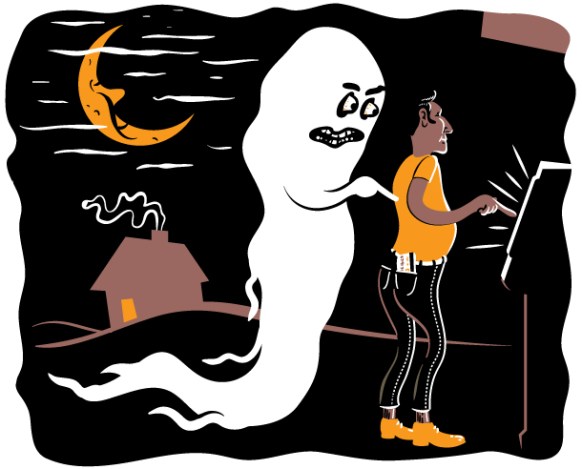
One time I was walking down an alley late at night. The clouds were gauzy over the moon. Suddenly a ghost jumped out at me. “Woah,” I said, because I was not expecting it, to be honest. “Sheesh,” I said, because I still hadn’t recovered. I shook my head at the ghost. I shook my finger at the ghost too, because . . . maybe a little more careful next time.

Then the ghost told me we were going to walk to the nearest ATM. The ghost was real scary, with horrible teeth and bloodshot eyes. I realized that the ghost was probably real out of it, having been dead so long and everything, so he probably needed help with the ATM machine. Withdrawing funds, or making a deposit. For the living, these actions are part of our daily routine. Not so for the dead. Not so. Maybe there’s no direct deposit in the afterlife. And the ghost need help depositing a paycheck. I tried to ask the ghost about this, but embarrassment at his lack of technological prowess made the ghost threaten me in alarmingly corporeal terms.

I’m quite capable with technology. I almost always complete my ATM transactions on the first or second try. I help my parents with their printer on a pretty regular basis, and they’re impressed with my ability to Google answers to their problems. I’m a bit of a techie, I guess. I just love the internet, and email, and gaming, and gamer culture, and hacker stuff. It’s how I’m wired. Get it? Email me if you get it.

Of course, I told the ghost I could help him. My tech skills are a point of pride.

The ghost wanted me to use my debit card when we got to the ATM, and I was like ,”Right—so he can see how a pro does.” The ghost was pretty specific about me withdrawing 300 dollars, even though I assured him it works the same with any amount. He was like, “I don’t flipping care.” I reproduce his harsh language here out of respect for the dead.

After my demonstration, the ghost seemed ready to leave.

I felt like I’d misjudged the situation. Now I saw that the ghost had unfinished business. He must have owed someone money. He’d chosen me as his Haley Joel Osment. I felt honored.

As this restless denizen of the netherworld left me, he whispered a word of warning: “Don’t tell the cops.” This baffled me. Of course I wouldn’t tell anyone. I knew I was the only one who could see him. I walked off home—a swing in my step, but a weight on my shoulders. I had been given a gift. One I would not take lightly.

An Honest Ghost