Driving Through

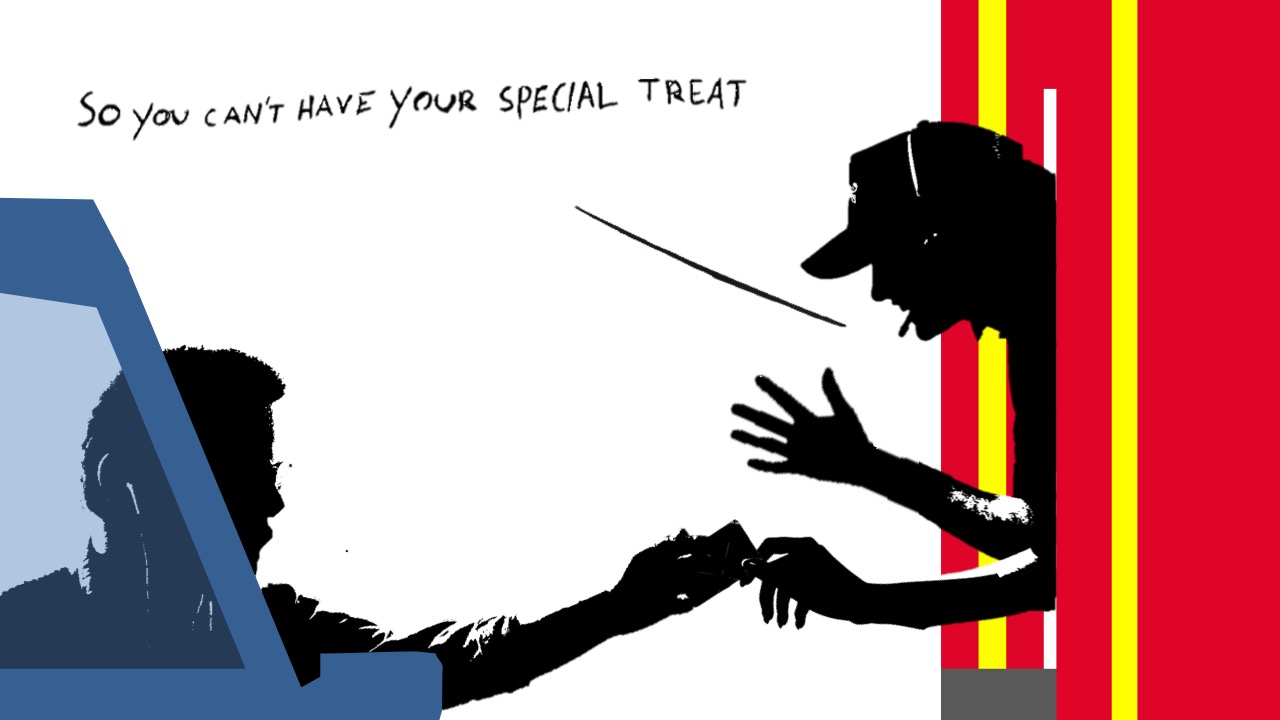
The other day I went through the McDonald’s drive through because I hate myself and love death, and I had my earbuds in, so the cashier asked me what I was listening to, and I said “Andy Shauf.” And he goes, “Cool, Andy Shaw. What kind of music does he do?”

When I’m on the spot in this way in a social situation—and it should be telling that I consider going through the McDonald’s drive-through to be a social situation—I’m trying to do a lot of things at the same time, and my brain doesn’t handle it well. I know that the answer I’m about to give is ridiculous, but I’m doing the math, trying to find another possible answer, and I can’t do it in the short time allotted, so a sheepish grin grows on my face and I say, “Baroque pop.”

“Baroque pop” is a very accurate answer. Andy Shauf’s music contains complex arrangements, and a healthy smattering of strings and wind instruments. That said, no one wants to talk to the human incarnation of Pitchfork.

But the cashier is an exceptional human being, and he doesn’t stare dumbly at me. He also doesn’t give me a look of searing scorn. He further, and this is what I appreciate the most, doesn’t act like it’s normal for someone in a conversation with a stranger to describe something as “baroque pop”. He gives me an amused chuckle, and says, “All right. Baroque pop. I’ll check it out. Andy Shaw.”

I want to correct him. He won’t check it out. There’s no Andy Shaw. It’s Andy Shauf. But there’s no way that I can make the conversation weirder by being the sort of person who is not only exacting about classifying a musician as “baroque pop” but must also must spell the name of the artist to a complete stranger, in a drive-through.

And I pass on to the next window. The interaction with the girl at the next window is a complete success. She hands me a bag of food I shouldn’t eat and I say—in recompense for all of my sins at the previous window, with much feeling—”Thank you very much. Have a great day.” I was so grateful for my sausage McMuffin, maybe alarmingly grateful. But the girl smiled and told me that I was welcome. I was glad to be welcome. I am glad there’s a place for me in this world. And that place is McDonald’s.
Driving Through

On Answering the Door

The doorbell rang. “Ugh,” I thought. I didn’t want to answer the door.

Can I just step aside for a second and ask, “Who does want to answer the door?”

Can I step aside from asking for a second and answer?

Here’s the answer:

No one wants to answer the door.

I guess one exception to that might be if you’re expecting a package. Then you’d be like, “Maybe it’s the package I ordered. Maybe it’s the trick salami that looks like salami but tastes like prosciutto that I ordered to freak out the squares at the big dance.”

Maybe it’s because you never actually ordered such a product, and maybe that’s because you never even found such a product on the internet to order, but that’s never what it is at the door.

Instead, it’s always a process server with a subpoena requiring me to appear in court for threatening to freak out the squares at the big dance with cured meat-type pranks. This time was no different.

“Ugh,” I thought. “Why did I even answer the door?” I said to myself in a sexy whisper as I closed the door, holding the subpoena. I looked at the door for a while, anger swelling my heart like bacteria in a curing sausage. Then I exhaled. I couldn’t stay mad at the door. It was just doing its job.

Then I looked into the eyes of my family. They were watching TV, so first I had to walk in front of the TV, and they yelled at me to move. So I sort of went from person to person, looking into their eyes and avoiding most of their punches.

That’s when I knew that everything was going to be okay.

Sometimes trials come along in our lives. Sometimes those trials are actual court trials in law courts. Trouble is always knocking at the door of our lives. But it’s hope that makes us open that door. And it’s hope in our families and America that helps us close that door on foreigners so that the United States can remain a pure nation, and not full or foreigners and the weird ghosts that follow them here from the old country.

To be honest, if we could open the door to the US real fast and just let the foreign people in, but then shut it real fast to keep out the weird ghosts, I think I’d be fine with a looser immigration policy.

But, hell—I really do think we need to keep those ghosts out. We’re going to have to break a few foreign eggs in order to make the omelette of democracy, on the sidewalk of the democracy, heated by the unrelenting sun of democracy. I’m a simple man, made up of American flags and bigotry, but this one thing I know: ghosts can pass right through doors, so there’s nothing we can do to really keep them out.

On Answering the Door

Daughter in a Coffee Shop

I took one of my daughters to a coffee shop. She’s eight years old. I order a coffee for myself and a cookie for her, and then she pipes up and says, “I’ll have a caramel Italian soda too.” That was not part of the plan, and it took me completely by surprise. She’s shy, but has an occasional flare up of fearlessness, usually when it involves her personal material gain. You can see that she has this furnace of desires tamped down, and sometimes oxygen rushes in and the fire flares up, and you can see the heat in her face.

She darts a glance at me, to gauge how I’m reacting to what she’s done. I smile at her. She’s done something brave, and the situation is slightly heightened by it, and if I say anything right in the moment, I could be backing her into a corner, and we might risk tears.

We sit at a table and talk about ghost stories. She’s into ghost stories at the moment, having realized she can hear a ghost story and sleep without nightmares. She makes a sudden gesture forward to emphasize a bony hand reaching out for someone’s neck in the dark, and spills her Italian soda. Horror shows on her face. She’d freighted the soda with meaning and that intensifies the loss. She snuck the soda in. It’s proof that she can control the universe and that her will here has an effect on matter. And now through a failure of will she’s lost a prize. It’s a little hard to watch this happen.

Recently, she lost a tooth, and requested in a letter that the tooth fairy let her keep the tooth so that she could play tricks on her friends, by removing the tooth suddenly, etc. But then she took to carrying the tooth all over the house and lost it. I could see that it wasn’t the loss of a tooth that bugged her. It was the loss of the potential enjoyment of tricking her friends, and being the kind of person who tricks her friends. She was destroyed. So I’m sensitive about this situation. But I’m also feeling a slight sensitivity about her getting whatever she wants. She pushed to get the soda, and now she’s lost it and it feels like maybe losing it is a good lesson too.

She’s almost in tears. “I want to get another,” she says. “I’m sorry,” I say. “You need to be more careful.”

She doesn’t cry, but she’s close. I smile at her, “Can you go get a rag, so we can clean this up?”

She won’t look at me, but then she nods. She goes to the counter. I look at my phone, and when she comes back she has a rag and another soda.

“How’d you get that?” I say.

“I told them what happened, and they gave me another one.”

I help her clean up the previous soda. I give her the rag, and send her back to the counter.

“Make sure to say thank you,” I say.

I watch her this time. She goes back to the counter. I can see her handing the rag back and talking to them. Thanking them, I assumed. Then the girl behind the counter moves to get retrieve something from the display case. She hands a cookie to my daughter. Lux walks back to me.

“They gave me a cookie!” she says. She can read a skepticism in my expression and is attempting to head it off.

“Why did they give you a cookie?” I say.

“Because they’re nice here,” she says, and she starts to eat the cookie.

“Did you just say ‘thank you’?”

“Well, I told them it was my birthday.”

I nod at this.

“But it’s not your birthday. Your birthday was months ago.”

“Not that long ago.”

“But that’s a lie.”

“If we came here on my birthday, they would give me a cookie. And we didn’t come here on my birthday, so they couldn’t give me a cookie. So they just gave me my birthday cookie today. It’s the same. It’s not a lie.”

“It is a lie.” I feel myself transforming into a parent who is about to teach my child something. I’ve been a parent for ten years, and I still become very aware of when I’m about to switch into important parenting moment mode. I hear myself talking in a way I don’t usually, and in a way that’s confusing. It’s like playing a song on the guitar and suddenly wondering if you actually know the chord that’s coming next, and then, because you made yourself think about whether or not you know the next chord, you completely forget the chord.

“Now I want you to go back to the counter and tell them that you lied.”

I dig some money out of my pocket.

“And go ahead and pay for the cookie.”

She doesn’t want to do this. She lowers her eyes and won’t meet mine.

“You need to go do this,” I say.

She turns and walks sullenly to the front.

I stand up to watch her. She walks to the counter. She stands there, gets the attention of the girl. Then, in a loud voice, she says, “My dad wanted me to tell you that he has a gun.” She looks back at me. We are almost out the door by the time the girl reacts at all.

“Uhhhhh . . .” the girl behind the counter says.

My daughter and I walk briskly down the street. We are both learning a number of things, and we are both teaching each other a number of things. She is learning that there is power in language. I am learning the limits of parenting.

Daughter in a Coffee Shop

Spy with Digestive Difficulties

Spy moves nonchalantly through the hotel lobby, pursuing the target, a smartly dressed man in oversized glasses. He follows the target into an elevator. He taps the button for a floor three higher than the target. Nonchalant.

His stomach gurgles loudly.

The target looks over at him. The spy acknowledges the man with a slight nod of the head.

His stomach gurgles again, loudly.

The spy turns pale. He grips the brass railing on the wall of the elevator, presses his head into the oak panel.

The elevator reaches the target’s floor. The door closes behind the target. The spy lunges for the button for the very next floor.

Spy (breathlessly): Hurry, hurry, hurry.

The door opens. He rushes into the hallway, and uses a tiny laser emitted by his phone to burn out the lock on the first room he comes to. He dashes into the bathroom.

***

Spy is locked in hand-to-hand combat with a henchman whose scarred lips turn up in an eternal sneer. His distinctive injuries have earned him the name “Grimace”, a name which he does not realize infringes on a copyright held by MacDonald’s. Grimace knees the spy in the stomach.

Spy: Holy jeez. I’m about to explode. Do not do that again. We’ll both regret it. Honestly.

Grimace nods and goes back to choking the spy. Spy looks relieved.

***

Explaining his situation to a newfound accomplice.

Spy: At this altitude I can stagger to a toilet 3 steps at a time  flat out before my legs start shaking.

***

The spy, in a crowded banquet hall, flirts with an attractive woman whose locket contains the launch codes.

Spy: Oh, good. I was hoping to get a nibble.

Woman: How about a bite?

The spy grabs an elaborate shrimp hors d’oeuvre from a passing waiter and offers it to the woman.

Spy: You first.

Woman: That’s how I like it.

He feeds her the morsel. She grabs an hors d’oeuvre from another plate. Holds it out to him.

Woman: Now you.

Spy (scrutinizing the contents of the cracker): Oooh. Cheese. I’ve got a whole history with dairy, and it will not be good. Is there another one of those shrimp ones? That looked good. Seriously. I’ll be . . . occupied for quite a while.

Woman looks disgusted. Spy shrugs.

***

Spy (talking to someone over his ear-piece): I’m worried that it might be physiological, or some kind of chronic disease. Just because it’s been so consistent. And I have various pains in my stomach and abdomen.

But then I think, what if it’s psychological? I’m under kind of a lot of stress. And previously it was my body saying, get this out of me, and that seems fear based. Like fight or flight.

But now I’m having a hard time making it happen. So it’s gone the other way. And that seems like, I don’t know, like I’m psychologically clenching and holding on to it. I do a lot of holding things in and pretending, and I wonder if my body is responding to that. My body is getting the message and doesn’t want to let go. Does this make any sense?

T (the technical advisor): I called to explain how the embeddable nano-tracker worked.

Spy: Right, but I thought we had a deeper relationship than that.

T: Do you want to know how it works?

Spy: Fine.

Spy makes faces mocking him during the explanation, and ends the call curtly as soon as T is finished.

***

Spy, on the toilet, finds and then texts a picture of the MacDonald’s character “Grimace” to the henchman. The spy shakes his head, smirks.

***

Spy enters the grocery store and approaches a clerk.

Spy: Do you guys carry really strong laxatives?

Clerk: Aisle 9.

Spy: Thanks, my wife is really constipated.

Clerk does not seem to realize laxatives are for the spy’s personal constipation. Spy suppresses a smug smile. He’s at the top of his game.

Spy with Digestive Difficulties

Scenes from the Library

A toddler wanders through the library, dropping books and babbling. In an instant, Carol, the librarian, appears in front of him.

“Be quiet,” she whispers.

The toddler turns around and walks the other way, still making noise. Instantly, Carol stands in front of him.

“Please, I’m warning you,” she whispers.

The toddler walks past her.

Carol detains the toddler. The police arrive and arrest him. The judge sentences the toddler to three years in prison.

At home, after the sentencing, Carol shakes her head. “I tried,” she thinks. She pours herself another scotch. No rocks, no soda. Both are too noisy.

***

Carol sits at her desk, reading quietly. She’s at peace.

Just then her head snaps up. Through the front doors she sees that a knight in full armor— with a one-man band bass-drum, holding cymbals—is about to walk through the door.

She snatches her walkie-talkie off the desk. She speaks calmly and evenly.

“This is Carol upstairs. I’m gonna need some back up.”

***

A library patron approaches the front desk. Carol stands—scanner at the ready.

The patron says, “How many books are we allowed to check out?”

Carol winces. She whispers, “The limit is twenty-five items. But, for future reference, we prefer the word ‘permitted’. ‘Allowed’ . . . it just sounds too . . . it actually contains one of our banned words.”

“What word is that?” the patron says. The patron looks annoyed.

Carols looks around.

“It contains the word ‘loud,'” she says. “And that doesn’t work for us.”

Carol points to a sign that says, “Quiet, Please.”

The patron blushes, and nods.

***

Carol faces off against Gloria, her fellow librarian, in a book scanning race. Beth, another librarian, judges the race. Beth holds an air horn, ready to call the race. Carol’s movement are assured and deliberate, very smooth. Gloria is working hard and she shows it. The library patrons watch, rapt.

Carol’s pile diminishes rapidly. Beth holds up the air horn and the patrons brace themselves in anticipation.

Carol finishes scanning her last book. Gloria still has a small pile. Beth presses the air horn. There’s no sound. Gloria stops. She huffs and puffs, defeated.

Beth smiles at the patrons.

“It’s empty,” she says. “The click of the button is enough.”

Carol says, “That’s just some library humor.”

The patrons laugh quietly, hands over their mouths.

***

Carol stops shelving books for a moment and looks at the fish tank. “Such beautiful creatures,” she whispers in her mind. “I wonder if I’ll ever know why I love them so much.”

Then she realizes why. “So quiet,” she thinks.

***

Library patrons gather around the front desk. Carol breaks breaks down her 9mm pistol, very quickly and very quietly.

Carol whispers, “And of course, I have a silencer.”

Everyone nods approvingly.

***

Carol is at a doctor’s appointment. The doctor places the stethoscope on her chest. He frowns and moves it. He waits. He frowns and moves it again. Then he stops. He smiles.

“There it is,” he says. “Nice and steady. But very quiet. I can barely hear it.”

“Thank you,” Carol whispers. “I’ve been working on that.”

Scenes from the Library

Crossing the Street

In early spring I was crossing the street on my bike at a spot that wasn’t a crosswalk. I’m happy to wait for an actual dead spot in the traffic. It was 5:00 pm, so there’s bound to be fewer dead spots in the traffic. Which I’m fine with. I can wait.

But there’s usually a good samaritan in the mix who sees a guy waiting on his bike at the edge of the road and thinks, “I’m going to make this idiot’s day.” Drivers think of grown men on bikes as idiots.

So the good samaritan slows down. But this creates a complicated social situation, because he’s given something to me. Now I owe him. I decide that my gift will be “getting across the road quickly.” There’s a tractor beam of social requirement on me now, and that feeling works on me.

Also, it’s at this point that I realize that I left the bike in a higher gear than I should have. I have to stand up to get the bike moving. I lock eyes with the good samaritan, and he sighs. And now a car in the far lane of traffic has stopped, and now cars are lining up.

It’s not taking me that long to get things going on my bike. But I’m wishing that I’d thought to downshift before I came to a stop. There’s nothing I can do about it now.

Except that I could make it worse. Because I’m fidgety in this moment of stress, I adjust my scarf. In doing this, my hand catches the cord of my earpods, and they pop out of my ears. I slow down in order to handle this new development. Cars are waiting on me and I slow down.

The earpods are still attached to my phone, and the ear pieces are hanging over my handlebars, and I’m concerned about where I am in the podcast. I have that thought, even though I’m trying to cross the street in front of these cars, holding them up.

I’m trying to keep up my momentum on the bike, but I’m also fumbling with the earpods. I want to recover the earpods and not miss anything on the podcast. My grabbing at the earpods causes them to drop them down so that they’re they’re dangling directly over the tire. I snatch at them again. This makes them descend further, and they’re caught in the spokes of my front tire.

I have been courting disaster, and now we’re getting married. I am marrying disaster. These cars are the witnesses. Thank you cars. Every driver in every car is thinking the word “idiot.” You could collect and quantify the data to prove that.

Of course, of course, of course, the earpods wind around the wheel, the wheel seizes, and I go down hard. I’ve skinned my knee. I am a grown man with children, and I’ve skinned my knee, torn a hole in my jeans in front of strangers.

I scramble to my feet. I grab my bike. I’m limping as I pick up my bike and start to walk it across the street. I’m forcing the bike across the street, not immediately comprehending that the front tire isn’t working. I’m confused by this. I stop. I’m in the middle of the road, holding up traffic, and I stop to examine the tire.

My earpods are wound around the spokes and have bound it up. I force the tire. It’s not giving. I’m trying to make the bike work. I should just pick the bike up and walk the rest of the way across the street. Instead I roll the bike hard, trying to free up the wheel. The wheel gives. The earpod cord jerks and I feel my phone leave my pocket.

My phone whips through the air and lands to my right, 5 feet in front of the car that initially stopped for me, the good samaritan. The good samaritan looks sad.

The wheel is still frozen. I drag the bike over to retrieve my phone. I hold the bike awkwardly as I lean down to pick the phone up. The glass of my phone’s screen is completely destroyed. I put it in my pocket and limp the rest of the way across the road. I force the bike tire as I go. It gives again. It pulls my earpods into pieces, shreds them to bits. They drop on to the pavement. I continue to the other side.

I’m alive. I’ve destroyed one pair of ear buds, a pair of jeans, and a phone. But I’m alive. And I’ve given a gift to the good samaritan. In fact, I’ve given a gift to two lanes of cars, probably a total of twelve cars. I’ve given them the catharsis of seeing someone who is not them do something as badly as a person can. No matter what their day has been up to this point, they now feel the thrill of success.

As for me, it’s 5:01 PM on a Monday and I have successfully crossed the street.

Crossing the Street

My Aesthetic Jam

In this story a guy who got hooked on eating chalk had a girlfriend whose dog abused him. That’s right. The dog abused the guy. What a mixed up world. The dog peed on his shoes. It chewed on his shoes like a dog from many popular media (television, movies) will sometimes do. The dog doled out abuse to the guy the same way a dog doles out kisses to a sweaty human. In short, this guy was really getting it from this dog. But he loved the girl, so he was willing to endure these tiny travesties. But, in a further twist, he did occasionally fantasize about what revenge on the dog would look like. He thought about kicking the dog out the window and the sound that the dog might make, assuming it did not strike a passerby on foot or bike, when it made contact with the slightly grainy cement of the sidewalk. He wasn’t a bad guy, and he didn’t act on any fantasies that he might have had about setting out a trail of cartoon sausage links that ran into traffic, so that the dog would gulp them in quick succession, while they remained linked——gulp them, and gulp them until he came directly into the path of a cement mixer. Even though he’d developed a psychological dependence on eating chalk in this story, and sometimes thought about visiting the bayou and pitting the dog against an alligator, he really wasn’t a rotten guy, which you saw because he loved the girl in the story, whose name, improbably, was Lacey. He hid his love of chalk from her, which isn’t a good practice in a relationship. Relationships should be founded on trust, and hiding something as important to you as eating chalk was to this guy . . . well, that’s not healthy. Overall though, a pretty alright guy, this guy.

I showed my wife this story and she objected to the guy having all these fantasies about doing harm to this dog.

“But the guy,” I said, “the guy is really getting it from the dog. I mean, if you saw the sheer volume of urine the dog unleashed on this guy’s nice leather shoes, crepe soled leather shoes, you’d feel the same way about the dog that the guy did.”

“That’s another problem I have with the story,” my wife said. “You spent a lot of time on the dog’s urine. I don’t want to know about dog urine at all. And I don’t want to know about the volume, scent, coloration, or viscosity of any creature’s urine.”

“Not even if one of our children had perpetually thick, green urine? Not even if all our children had perpetually thick, green urine?” I said the previous with raised eyebrows to indicate what a strong point I’d made.

“I don’t want to spend more time in this conversation, for the same reason I don’t want to spend any more time in the world of that story, with its focus on a protagonist that considers doing harm to dogs, and with its preoccupation with the taxonomical characteristics of dog urine. The reason is that it’s gross and unpleasant. I feel like the story doesn’t want me to read it. Like I’m walking in through the door of the story, but there the story is on the other side of the door pushing back against me, trying to keep me out.”

I saw her point, but now I was thinking, “It’s on.” I responded:

“So the story is a thing that you can walk into, like it’s a house. But it’s also a person inside the house that will bar the door and keep you out. You’re muddling your metaphors, which as a writer is something that matters a lot to me. Clear communication and un-muddled metaphors. It’s like the basic level for me as a writer.”

“But this is real life,” my wife said. “And I talk in occasionally mixed metaphors with imperfect grammar, and have an honest reaction to things like people wanting to hurt dogs.”

I said, “But it’s a fictional world. You walk through the turnstiles and you’re somewhere else, and the rules are a little bit different. In this world, this guy isn’t so bad. He doesn’t actually hurt the dog, anyway. He just thinks about it, but is prevented by love. He’s willing to deny himself for love.”

“So why can’t you,” my wife said, ”deny yourself for love, and write a story where a guy doesn’t want to hurt small domestic pets and get them run over by cement mixers and stuff? Maybe you could do that.”

I took a deep breath and adjusted my beanie, pulling it down towards the reappearing pimple in the middle of my forehead, hoping that if I covered it up, my wife would have to take me seriously. But pulling the beanie down far enough to cover up the pimple made me look just as, if not more, ridiculous.

“Characters who fantasize about getting revenge against vindictive dogs are my aesthetic jam,” I said

“Your aesthetic jam is like a cheese grater applied to the face of my aesthetic sensibilities,” my wife said.

I said, “The story uses that guy to represent something that the story doesn’t affirm. The story doesn’t think it’s good that the guy wants to hurt the dog. By making a comic figure of the guy, the story argues in favor of not fantasizing about hurting dogs.”

“But I still had to read about a guy using a quote ‘juicy steak’ to lead the dog into a quote ‘really scary funhouse’ where the dog would suffer a massive coronary. Why do you want me to put that into my brain? What’s up with that? What’s wrong with you?”

So I tried to write something my wife would like. I changed the stuff about the guy wishing the dog would follow the artfully thrown chew toy into the dryer, and that the rest would be history. I changed all that stuff because I love my wife. I made the story about a guy who’s grown psychologically dependent on eating chalk, and who’s also in love with his girlfriend’s dog, and tolerates her presence in order to be close to the dog.

I showed it to my wife, and she didn’t like that story either.

My Aesthetic Jam

Pets in the Workplace

August 13th, 2014
Matt,
Quick note . . . I think your dog hates me. Last time you brought Patches into the office he wagged his tail as I was petting him, but yesterday there was a coldness in his gaze that I found unsettling. I think you should talk to him. Or I could. Just let me know what makes the most sense to you.

Regards,
David

August 19th, 2014
Tricia,
Do you know if Pippy is unhappy with something I said to her this last Friday? I was honestly just trying to keep up the banter when I asked her if she was a pretty bird. I wasn’t trying to be weird. But then she didn’t say anything, and I felt like she might have taken it weird, or maybe she was just messing with me? Are cockatoos into those kinds of mind games? Maybe next time you bring her to work you should just avoid me.

Regards,
David

August 23rd, 2014
All,
I’m writing a formal apology for last night. I’ve been dealing with a lot of stress as we’ve been closing in on the merger, but that’s no excuse. To make it clear, Ben is not fired. I would never fire anyone for something his or her cats did. I do not retract my statements about Pepper and Jocasta (the sooner they’re burning in hell the better), but I admit that I went overboard when I threatened to bag Henrietta and tie her to the nearest pitbull.

It seems likely to me now that she didn’t realize what a zen garden is for and that I misinterpreted her natural curiosity—and then her natural waste voiding functions—as her calling my newfound interest in Buddhism pretentious. Normally, I would say that ignorance isn’t really an excuse, but I think animals deserve a little leeway as we humans have persecuted them ceaselessly since we dethroned them as rulers of the earth in the ‘60s.

Apologies,
David Henry
CEO of Trailway Industries

Pets in the Workplace